

Date:
2025
Location:
Elche, Spain
Client:
SUEZ Air & Climate
Final users:
Municipality of Elche
Deployment:
12 units
Parameters:
NO, NO₂, O₃, CO, SO₂, VOCs, PM₂.₅, PM₁₀, noise, temperature, humidity, pressure and rain
Technologies used:
Challenge
Elche City Council has committed to advanced air quality monitoring as a key tool for improving urban environmental management, strengthening public health policies and supporting the implementation of the Low Emission Zone (LEZ).
The project addresses the need for reliable, continuous and highly accurate data on air pollution and the impact of road traffic in various urban centres within the municipality, including strategic districts.
Objectives
- To continuously monitor air quality at various points within the municipal area.
- To analyse the impact of traffic and mobility on pollution levels.
- To provide objective data for planning the Low Emission Zone (LEZ) and other environmental policies.
- To facilitate data-driven decision-making by the City Council.
- To improve transparency and the provision of information to the public.
Solution

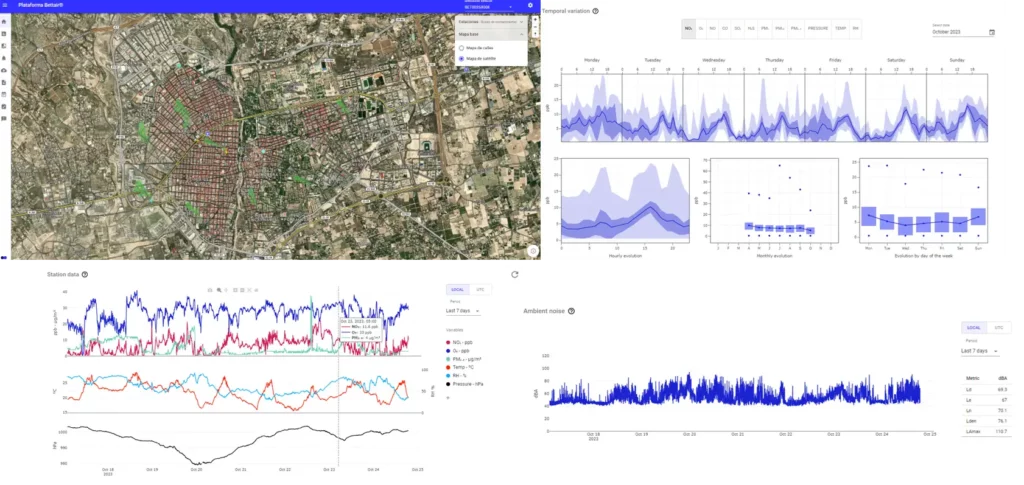
To meet these objectives, Elche City Council has deployed 12 bettair® air quality monitoring devices, installed at various locations across the municipality, including urban areas and districts such as El Altet and Torrellano.
The bettair® solution enables:
- High-precision measurement of air pollutants such as NO, NO₂, O₃, CO, SO₂ and VOCs.
- Monitoring of PM₂.₅ and PM₁₀ particulate matter.
- Access to continuous data that is comparable over time.
- Integration of the information into Smart City platforms for use and analysis.
Practical application of the data
The data collected by bettair® sensors is used to:
- Assess the actual impact of road traffic on air quality.
- Identify areas and times of day with higher levels of pollution.
- Support the design and monitoring of the Low Emission Zone.
- Develop evidence-based mobility and sustainability measures.
- Produce technical reports and environmental metrics aligned with urban and sustainability plans.
Outcomes
- Availability of reliable, high-quality environmental information.
- Improved municipal capacity to plan mobility and environmental policies.
- Strengthening of the municipality’s Smart City strategy.
- Direct contribution to public health and urban sustainability objectives.
- Project aligned with current and future regulatory requirements regarding air quality.
Categories:
Sectors:
Share it